Brand Like the Giants: A Midwest Guide to Unforgettable Branding in 2026
Do You Have a Brand, Or Just a Logo?
Most local businesses in Wisconsin, Minnesota, and Iowa have a logo, a couple of colors, and a Facebook page—but not a brand.
A brand is the feeling people have when they see your name, the story they tell themselves about you, and the trust they build with you over time. It shows up in your website, your videos, your photography, your emails, and even how you answer the phone. When that experience is clear and consistent, you don’t just get customers—you create fans.
“If people don’t know what you stand for, they’ll never believe in what you sell.”
What the Best Brands Know That Most Local Businesses Don’t
The world’s strongest brands—Apple, Netflix, Ralph Lauren—are not accidents. They’re built on three branding fundamentals any Midwest business can copy:
A clear story that makes the customer the hero
A consistent visual and verbal identity
A system for learning from their audience and refining over time
Think of this as the difference between throwing out random ads and building a living, breathing brand that compounds in value year after year.
Your Brand Story (Words Before Visuals)
Before the first logo sketch or video frame, strong brands start with words.
Educators like Chris Do talk about “strategy before design”—defining your brand’s promise, personality, and positioning before you ever touch visuals. Tony Robbins frames it as knowing exactly who your customers are, what they fear, what they desire, and how you transform their situation.
Your brand story should answer three simple questions:
Who are you really for?
What pain do you remove or desire do you fulfill?
What is different about the way you do it?
For a Midwestern business, that might sound like:
“We help busy business owners finally look as professional online as they are in real life.”
“We give family‑run companies a brand that can stand next to national chains.”
“We turn confusing marketing into a clear, repeatable system.”
When Morrison Media says, “Do what you love, we’ll do the rest,” that’s a brand promise: you focus on your craft, they handle the strategy, content, and execution. Every visual and video should reinforce that promise.
“Strategy is just a fancy word for deciding what you won’t do.” – Often echoed in branding circles and by strategy educators
Visual Branding That Speaks Without Words
Once your story is clear, the visuals become the megaphone—not the message.
Look at how some global leaders do it:
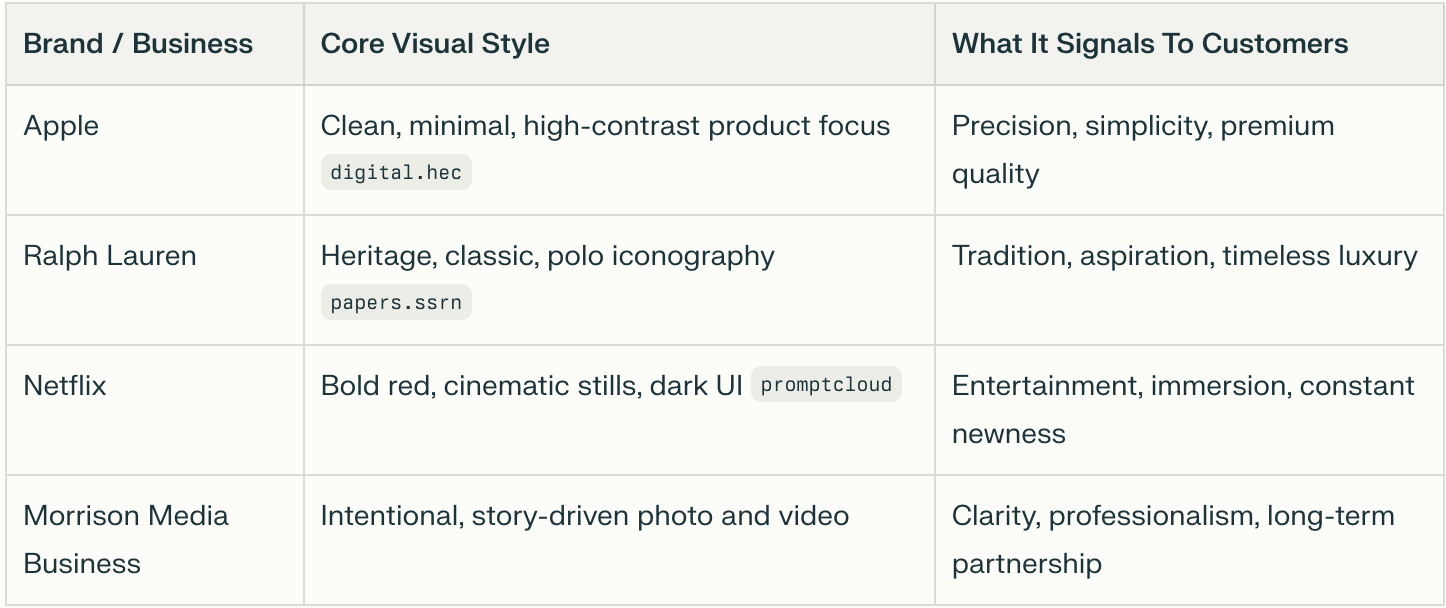
Apple uses clean, minimal visuals, generous white space, and bold product photography that instantly signals “simple, premium, intuitive.”
Ralph Lauren leans on heritage imagery, classic typography, and lifestyle scenes that evoke timeless luxury and an aspirational “American Dream.”
Netflix uses bold red, cinematic stills, and dark backgrounds that feel immersive and entertainment‑driven.
You can’t mistake any of them for someone else—even if you covered the logo.
Simple visual decisions that build a real brand
Choose a photography style (bright and airy, moody and cinematic, or somewhere in between) and stick with it.
Decide how you’ll use text on screen in your videos: clean lower thirds, bold hooks, consistent fonts.
Pick 2–3 core colors that reflect your personality and use them everywhere—website, social, video graphics, slide decks.
As a visual content partner, this is where you shine. You’re not just making “pretty pictures”; you’re establishing a recognizable visual language for your clients so their audience can spot them instantly in a noisy feed.
Branded Experiences, Not One‑Off Assets
Branding is not a one‑time design project; it’s an ongoing experience.
Netflix doesn’t just have a logo; it has a branded experience every time you log in—customized rows, smart recommendations, and a layout that always feels like “Netflix.” Apple does the same from packaging to store experience to keynote videos. Ralph Lauren extends branding from its clothes to its stores, website, and even music and scent.
For a local business, that might look like:
A branded landing page video that greets visitors with the same tone as your in‑person customer service.
Social clips that use the same colors, text style, and voice as your website copy.
Email newsletters that echo the same story your sales team tells on the phone.
The goal: whether someone sees you on Instagram, walks into your lobby, or lands on your website, they should feel like they’ve met the same brand.
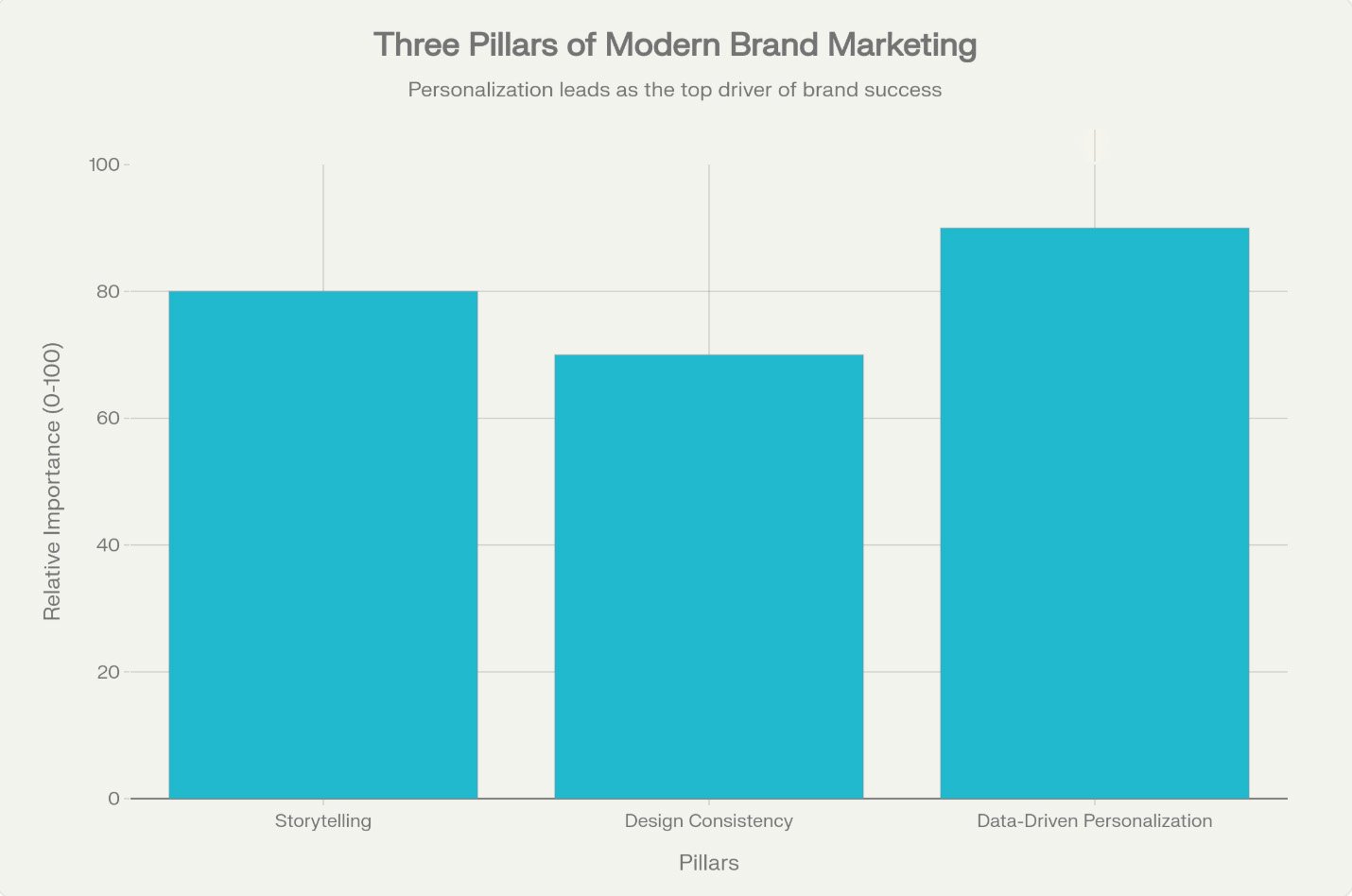
The Three Pillars of Modern Brand Marketing
Every standout brand—from Apple to Netflix—builds on three core pillars: storytelling, design consistency, and data‑driven personalization.
Pillar One: Storytelling That Sells Emotion, Not Features
Apple does not just sell phones; it sells creativity, simplicity, and empowerment through emotionally driven storytelling. Their campaigns use suspense, surprise, and empathy—like “Shot on iPhone,” which turns everyday users into heroes—to connect with people on a human level.
Ralph Lauren has spent decades telling one story over and over: a romantic, aspirational version of the “American Dream.” By tying its products to heritage, lifestyle, and emotion, the brand feels bigger than any single collection or season.
“People don’t buy what you do; they buy the story they tell themselves about what it means.” – Paraphrasing a core principle echoed in modern brand strategy literature and by educators like Chris Do
How a Midwest business can apply this
Turn case studies into character‑driven stories: the frustrated customer, the turning point, the transformation your product or service created.
Use video to “show, don’t tell” your process—diagnose, solve, execute—so prospects experience what it feels like to work with you.
Make your clients, not your company, the hero in your social content and landing page videos.
Pillar Two: Design Consistency That Builds Instant Trust
Chris Do teaches that strong brands start with words, then translate those words into visuals—typography, imagery, and layout that feel like one unified personality every time someone encounters the brand. This is why Apple’s minimal, clean design language is recognized even with the logo covered.
Ralph Lauren does the same with a different visual vocabulary: heritage imagery, classic typography, equestrian and collegiate motifs, and the iconic polo player—all reinforcing its luxury‑meets‑tradition positioning. Over time, this visual consistency trains the customer’s brain to recognize and trust the brand instantly.
Pillar Three: Data‑Driven Personalization (The Netflix Effect)
Netflix has built an empire on one idea: know your audience like a friend, then personalize every touchpoint around them. Their recommendation engine analyzes viewing behavior and location so no two users see the exact same homepage, thumbnails, or suggestions.
This same principle applies to small‑business marketing. When you tailor content, offers, and messaging based on what your audience actually watches, reads, or clicks, your brand feels personal instead of generic. Tony Robbins frames this as “knowing who your customers are and what they want and need,” then educating them on why your solution fits.
Simple personalization moves for local businesses
Use segmented email campaigns based on previous engagement—what content they viewed, what services they inquired about, or where they are located.
Edit variations of the same core video—one for first‑time visitors, one for warm leads, one for current clients—and deploy them on the right channels.
Customize landing page copy by industry (schools, healthcare, trades, nonprofit) to mirror the language your prospects already use.
The Morrison Media Branding Framework (Inspired by the Giants)
Morrison Media’s existing process—diagnose the issue, find the best solution, execute the plan—is already a strong strategic spine for modern brand building. When you overlay the Apple/Ralph Lauren/Netflix playbook on top of that, you get a repeatable system any Midwest business can understand.
Step One: Diagnose the brand gap
Clarify the core story: who you serve, what you solve, and why it matters now.
Audit visuals: do logo, photography, video, and copy feel like they all come from the same personality?
Analyze current data: website behavior, social engagement, and email performance to find where attention is leaking.
“If you can’t describe your brand in a sentence your customer cares about, you don’t have a strategy yet.” – A principle widely stressed in brand strategy education like The Futur’s content
Step Two: Design the story and system
Develop a brand story arc modeled after Apple’s emotional storytelling but tailored to local audiences and industries.
Define a practical visual system—photography style, color use, motion, on‑screen text—that can be reused across campaigns.
Map a data plan: what you will track (clicks, views, inquiries) and how that will inform future content and offers.
Step Three: Execute and iterate with content
Produce cornerstone video assets: a landing page video, social cut‑downs, and internal explainer pieces—exactly what you are already delivering for clients like Wisconsin Challenge Academy and Unity Fitness.
Deploy across channels with a clear schedule, repurposing clips for short‑form social, YouTube, and email embeds.
Review the numbers monthly, then refine script angles, hooks, and visual treatments based on real‑world performance.
The Morrison Media Approach to Branding: Diagnose, Design, Execute
You already have a simple, brand‑friendly process:
1. Diagnose the Brand Problem
Clarify what the business wants to be known for—and what it is actually known for now.
Identify where the current visuals and messaging feel disjointed.
Ask: “If your best customer described you in one sentence, what would they say?”
2. Design the Brand Story and Identity
Turn that diagnosis into a clear, one‑sentence brand promise.
Build a visual direction around it: photography style, video approach, graphic system, and tone of voice.
Plan cornerstone assets—landing page videos, photo libraries, and social templates—that can be reused and repurposed.
3. Execute the Plan and Refine
Produce the content: film, photograph, and write with the brand story front and center.
Roll it out across the website, social, and email in a coordinated way—not random posts.
Review results, ask what resonated, and fine‑tune the next wave of content.
This turns “we need some photos and video” into “we are building a recognizable, trusted, long‑term brand.”
For more tips and tricks like this, please visit www.morrisonmediallc.com - Morrison Media, LLC, where the pros go!
